

“Iran’s neighbors must understand that security and development without Iran no longer exist; it is either collective security or collective insecurity.”
This line from Iranian academic Saeed Ajorloo captures the essence of Tehran’s position in this war and the logic behind what it is seeking in any negotiated outcome.
Over a month into a war launched by Trump and Netanyahu, Iran has remained firm in rejecting the terms put forward by the Trump administration. Instead, it has advanced its own counterproposals, aimed not at a temporary ceasefire but at a permanent end to the conflict, while using its leverage over the Strait of Hormuz to secure lasting security and economic gains.
The backdrop to all of this is of course a total collapse of trust. Iran has now faced two surprise attacks by the United States and Israel in less than a year, both occurring in the context of ongoing negotiations.
More broadly, since Trump withdrew from the 2015 nuclear deal, the United States has pursued a “maximum pressure” campaign, imposing severe sanctions while advancing maximalist demands that Iran dismantle its nuclear program, give up its missile capabilities, and abandon its regional allies. In effect, Iran is being asked to disarm and fundamentally weaken its ability to defend itself against future attack.
Trump has maintained these demands throughout, including in the negotiations leading up to this war, when by many accounts a deal stronger than the 2015 agreement was within reach but did not amount to the kind of capitulation he sought, and in the reported 15-point U.S. proposal transmitted via Pakistan during the war.
Yet this war has not gone Trump’s way. Rather than bringing about the collapse of the Iranian government, or even consequentially degrading its ability to respond, Iran has continued to strike back with drones and missiles, hitting critical regional infrastructure as well as U.S. assets and bases. Most importantly, it has maintained an effective closure of the Strait of Hormuz.
It is this final piece of leverage that has fundamentally shifted the strategic equation in Iran’s favor. By restricting the flow of hydrocarbons out of a region that supplies a substantial share of global oil and gas, as well as other critical commodities such as fertilizers, Iran has created real pressure on the U.S. and the global economy. It is seeking to use this leverage to secure a favorable settlement, and is highly unlikely to relinquish it, even if Trump follows through on his threats to “blow up the country.”
Those threats have hung over the war for weeks, with attention fixated on Trump’s rolling deadlines for attacking Iran’s power plants and energy infrastructure.
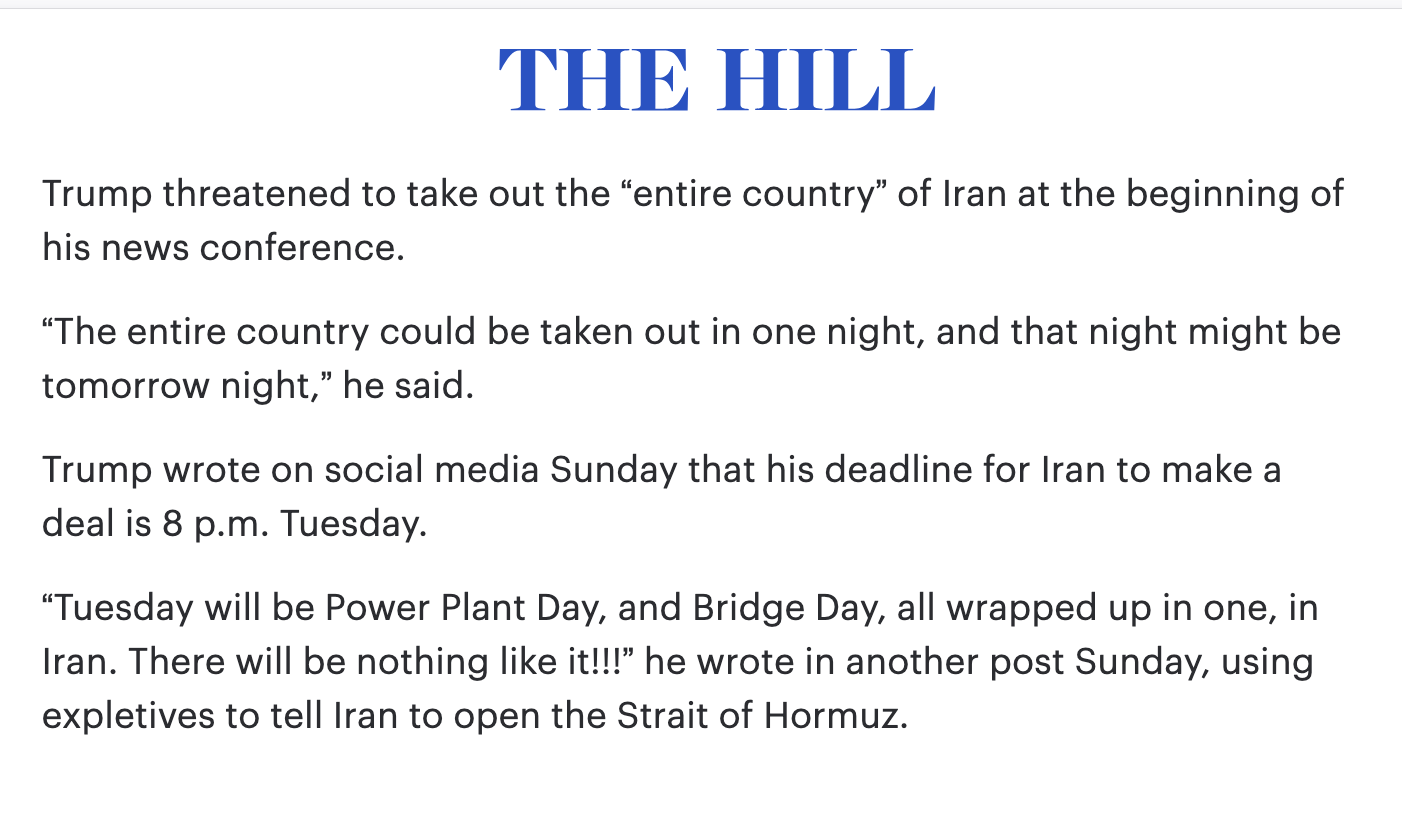
On Sunday, Trump escalated the rhetoric further:
“The entire country could be taken out in one night, and that night might be tomorrow night.”
He followed with a firm deadline of 8 p.m. Tuesday, and added:
“Tuesday will be Power Plant Day, and Bridge Day, all wrapped up in one, in Iran. There will be nothing like it!!!”
But this framing obscures a key reality. The war has already crossed that threshold.
Since March 27, the United States has been systematically targeting Iran’s civilian and strategic infrastructure. Under the cover of deadlines and high-profile threats, these attacks have become normalized, receding into the background of the war.
A wide range of critical facilities have been hit, including major steel production centers, the Pasteur Institute, one of Iran’s oldest medical and pharmaceutical institutions, the B1 Bridge in Karaj, advanced research hubs at Shahid Beheshti University, the National AI Platform at Sharif University of Technology, and petrochemical complexes in Assaluyeh and Mahshahr.
These are not marginal targets. They are core pillars of Iran’s economy, scientific capacity, and long-term development.
They employ tens, and in some cases hundreds of thousands of people. Their disruption will ripple across the lives of roughly 90 million Iranians.
In other words, the infrastructure war is not looming. It is already underway.
But what does this mean if Iran is still not capitulating? It means Tehran is unlikely to give ground on its core interests, above all its control over the Strait of Hormuz, no matter the cost.
This is its most powerful source of leverage, and one for which there is no clear military solution. If anything, the more Iran’s infrastructure is targeted, the more valuable this leverage becomes.
Iran will seek to use it not only to shape the outcome of this war, but to secure its economic future after it, through tolls, transit control, and bilateral arrangements with countries that have until now largely complied with U.S. sanctions.
Trump now finds himself in a strategic deadlock. Early in the war, he spoke openly about shaping Iran’s future leadership, reflecting a belief that the conflict could lead to regime change.
Even short of that, the expectation appears to have been that initial strikes would weaken the Islamic Republic enough to strip it of the ability to mount a meaningful response or follow through on its threats.
None of that has happened. Instead, the objectives of the war have visibly narrowed. As even Pakistan’s defense minister recently noted, the goalposts have shifted from toppling Iran’s political system to simply reopening the Strait of Hormuz.
Trump now faces a narrowing set of options, none of them good. The war could end without reopening the Strait of Hormuz, a costly outcome that would underscore the failure of his objectives, carry political consequences at home, and mark a strategic setback for the United States on the global stage.
It could drag on in its current form of attacks on critical infrastructure, despite his clear preference for a short war, with the expanding energy conflict imposing escalating costs on the U.S. and the global economy.
Or he could escalate into ground operations, such as targeting key islands like Kharg, a move that risks heavy U.S. casualties and would be very likely to deepen the deadlock.
Meanwhile, a comprehensive diplomatic settlement remains the least likely outcome. Even partial concessions, such as allowing Iran to resume oil sales, may not suffice if Tehran is focused on establishing a new strategic and legal order over the Strait itself.
In this context, a cornered Trump becomes more dangerous, with escalation becoming the default tool to break a stalemate, even if it means intensifying attacks on Iran’s infrastructure while the Strait remains closed.
Whether Iran’s threats to widen the conflict, including targeting regional energy infrastructure and key chokepoints, can deter such a move remains uncertain as Trump’s Tuesday deadline approaches.
As you said, the destruction of the civilian infrastructures is already on the way. The destruction of residential buildings, Pastour institute, universities, B1 bridge, cultural heritage sites, etc. all war crimes that have already happened. Their main goal is to destroy Iran and kill all Iranians, not only in Iran but now also in Lebanon, like what they did in Ghaza, another genocide!