

More than a month into a war of choice with Iran, Donald Trump is escalating. His rhetoric is more aggressive, the scope of US and Israeli strikes has expanded, and reports point to a buildup of ground forces that could signal preparations for a possible invasion. At the same time, the targets inside Iran are increasingly hitting civilian infrastructure, including bridges, pharmaceutical facilities, and universities.
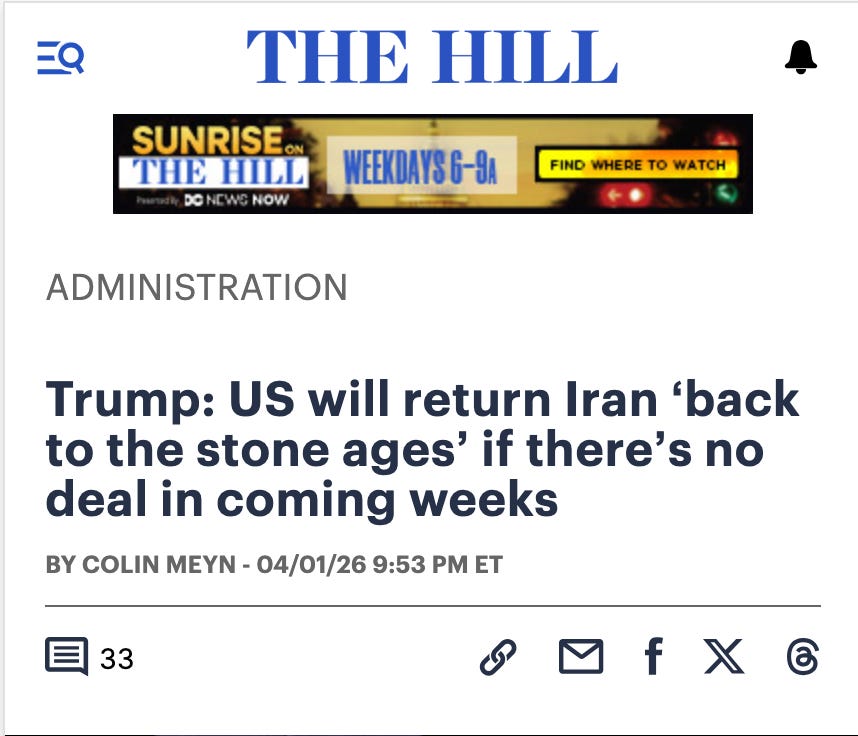
Iran, for its part, continues to sustain and even intensify its response, launching missiles and drones across the region and firing one of its largest salvos yet at Israel yet on April 1.
That reality tells us something important. After more than a month of intense U.S. and Israeli airstrikes, Iran’s core means of fighting back remain intact.
In this context, what we are seeing from the U.S. and Israel is a shift from counterforce targeting, aimed at degrading military assets (as they have failed to eliminate them), toward countervalue targeting, which focuses on civilian infrastructure and economic capacity. The logic is to increase pressure on Iran’s leadership by raising the cost across society as a whole.
The central question is this: why is Iran not backing down despite mounting pressure and escalating costs? The answer is that Iran does not believe it can safely do so. From Tehran’s perspective, conceding without securing its core interests risks long term weakening and would leave the country on a path to collapse anyway.
To understand why, this war has to be seen as the continuation of a strategy that dates back to Trump’s first term.
After withdrawing from the 2015 nuclear deal, which had successfully constrained Iran’s nuclear program, Trump pursued what he called “maximum pressure” policy against Iran starting in 2018. The goal was not limited concessions. It was full-on capitulation.
The demands reflected that ambition. Iran was expected to give up uranium enrichment, dismantle its ballistic missile program, and abandon its regional alliances. For Iran, this amounted to giving up the core tools it uses to deter attack and defend itself. In Tehran’s view, accepting those terms would leave the country completely exposed, much like Libya after it gave up its nuclear program, a move that was later followed by U.S. and European military attack in 2011 that helped bring about the collapse of the Libyan state (with the country mired in civil war to this day).
Iran has consistently rejected these maximalist demands, even as it continued to engage in negotiations. Those talks were twice interrupted by surprise attacks, first in June 2025 and again in February 2026. According to reports, in the latest round just before this war, Iran was willing to go beyond the 2015 deal by accepting stricter limits on enrichment, including permanent constraints, and even accepted proposals to internationalize parts of its nuclear program. Yet even that was not enough. Trump instead wanted total Iranian capitulation.
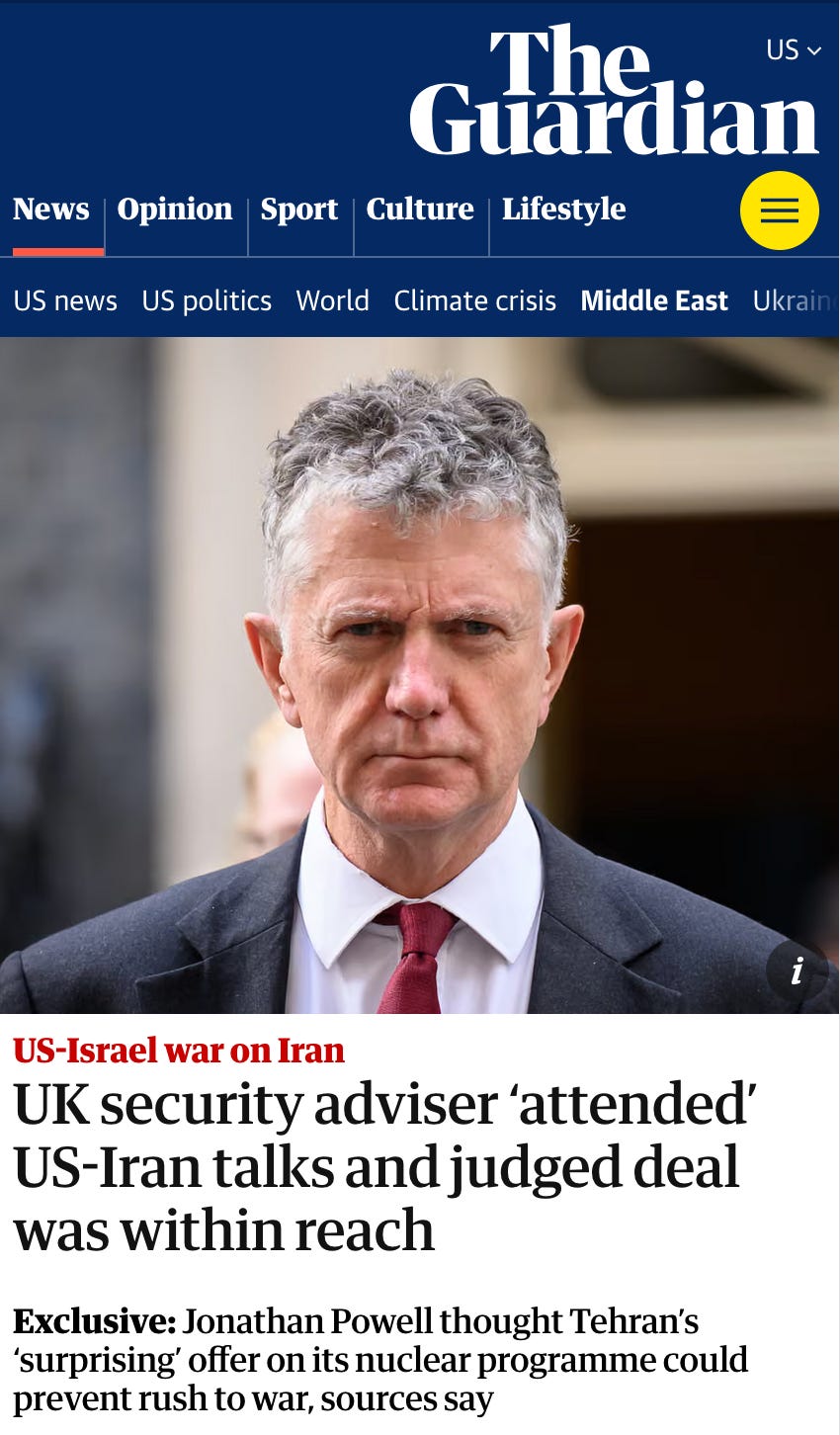
Trump’s “strategy” rested on a core assumption that Iran had been weakened to the point of total vulnerability, essentially reduced to a paper tiger, and that sustained pressure backed by military force would compel collapse or surrender.
The war has now definitively shown how deeply flawed that assumption was.
Instead, Iran has responded by expanding the conflict across the region. It has targeted US and Israeli assets across the region, struck infrastructure linked to US operations, and disrupted energy flows by closing the Strait of Hormuz. Despite weeks of severe bombardment, Iran has remained cohesive politically and maintained its rate of missile and drone attacks.
The result is a clear deadlock in the war. The United States is escalating, while Iran is not backing down. Washington insists negotiations are underway. Tehran insists they are not.
To understand why, you have to look at how Iran sees this war.
Inside Iran, the dominant view is that this war is the culmination of a longer campaign that began in 2018. What Iranian analysts often describe is a gradual strategy of pressure that includes sanctions, sabotage, assassinations, and periodic strikes. Taken together, they see this as an attempt to weaken and collapse the state over time.
In other words, they believe they have been facing a sustained strategy of attrition, a kind of death by a thousand cuts.
In that context, calls for negotiation are not viewed as off ramps by themselves. They are seen as efforts to freeze the conflict after failing to achieve a decisive outcome, just like happened after the 12-day War in June.
For Iran, a ceasefire at this juncture without clear guarantees is not seen as stabilizing. It is seen as accelerating a process that could lead to deeper instability or even fragmentation after the war, i.e. getting destroyed anyways.
Put plainly, this is an existential war for Iran.
This logic leads to a very different strategy than what many in Washington assume.
Iran is not hoping to win a conventional military victory. It is trying to deny its adversaries a decisive one.
The way it is doing this reflects a coherent strategy. It is absorbing major blows. And it widening the conflict into areas where the United States cannot fully control the outcome. The Strait of Hormuz closure and its impact on energy markets and shipping routes are central to this. So is the decision to treat Persian Gulf Arab states as extensions of US power, since American forces operate from their territory.
At the same time, Iranian analysts do expect the war to end in negotiation. But not under a pattern of fighting, pausing, and then returning to conflict.
What Iran is seeking is a fundamentally different outcome. It wants a real economic horizon after the war, including access to its frozen assets and meaningful sanctions relief. It wants an end to coordinated military pressure on itself and its regional allies. And it wants credible guarantees that the cycle will not simply repeat.
There are also clear red lines. Iran is not willing to dismantle its core deterrent capabilities or accept a deal that leaves it weaker in the next round of confrontation.
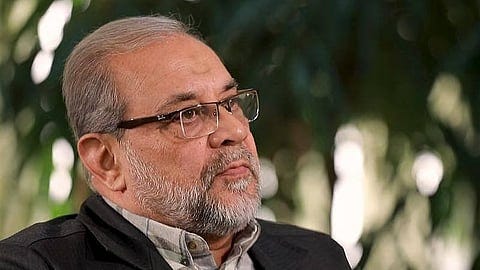
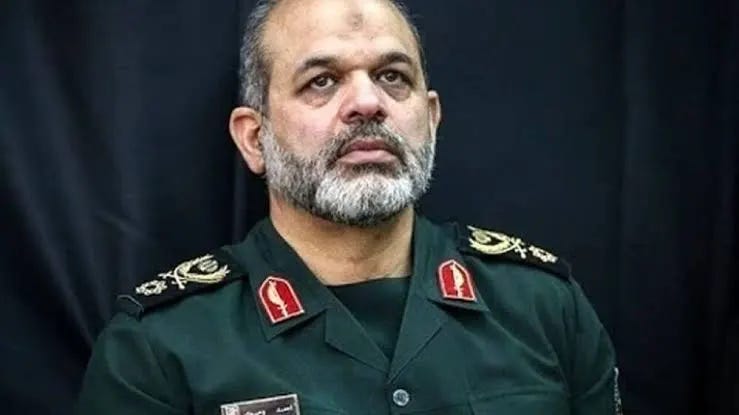
All of this is reinforced by internal political shifts. The assassination of more pragmatic figures such as Ali Larijani, and his replacement by a hardliner like Mohammad Baqer Zolqadr, point to a consolidation of power around Mojtaba Khamenei’s circle. This is also reflected in the leadership of the Revolutionary Guards under Ahmad Vahidi, another figure closely aligned with that camp. As a result of the war, power has become more concentrated and more firmly anchored in the hardline security establishment. These actors have long been skeptical of compromise and are more inclined to approach the conflict in long term strategic terms.
The result is a system that is less flexible but more cohesive in its outlook.
From the outside, this can look like stubbornness or escalation for its own sake. From inside Iran, it follows a clear logic. If Iran backs down without securing its core interests, it will end up facing more destruction anyways.
That is why escalation has not produced capitulation. It is also why it is unlikely to do so going forward.
Iran’s threats to strike regional energy infrastructure if its own facilities come under attack are credible, as are its threats to counter escalate more broadly. From Tehran’s perspective, if it faces the prospect of being greatly weakened or destroyed regardless, it has no reason to hold back.
here's a short letter I sent to my 3 reps in USA federal congress [feel free to use or modify]:
-------
The war against Iran should never have been started... sanctions should have ended in 1980... and Israel is a horror show which needs to be erased.
Donald Trump, unsuccessful at destroying Iran's military, has now ordered degradation of civilian infrastructure. This strategy is war crime on a massive scale... making every American soldier who takes part a war criminal, from top to bottom.
You must raise the alarm throughout congress to end this criminal war on Israel's behalf, end the sanctions, and pay reparations to Iran, Lebanon and Palestine.
-------
--= WAR CRIMES =--
to anyone in the family of a USA soldier deployed to the Iran theatre: implore that soldier to refuse unlawful orders... every action against the laws of sovereign nation Iran at this point is a war crime, since congress has not authorized war declaration
not only that, but as Iran gets attacked it retaliates by doing great economic damage to USA... so by attacking Iran, our soldiers are hurting USA... which they are supposed to defend!!